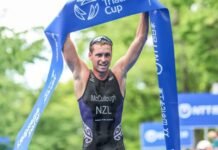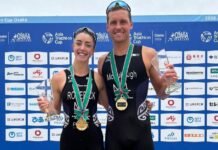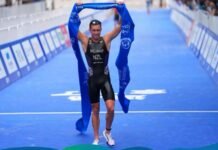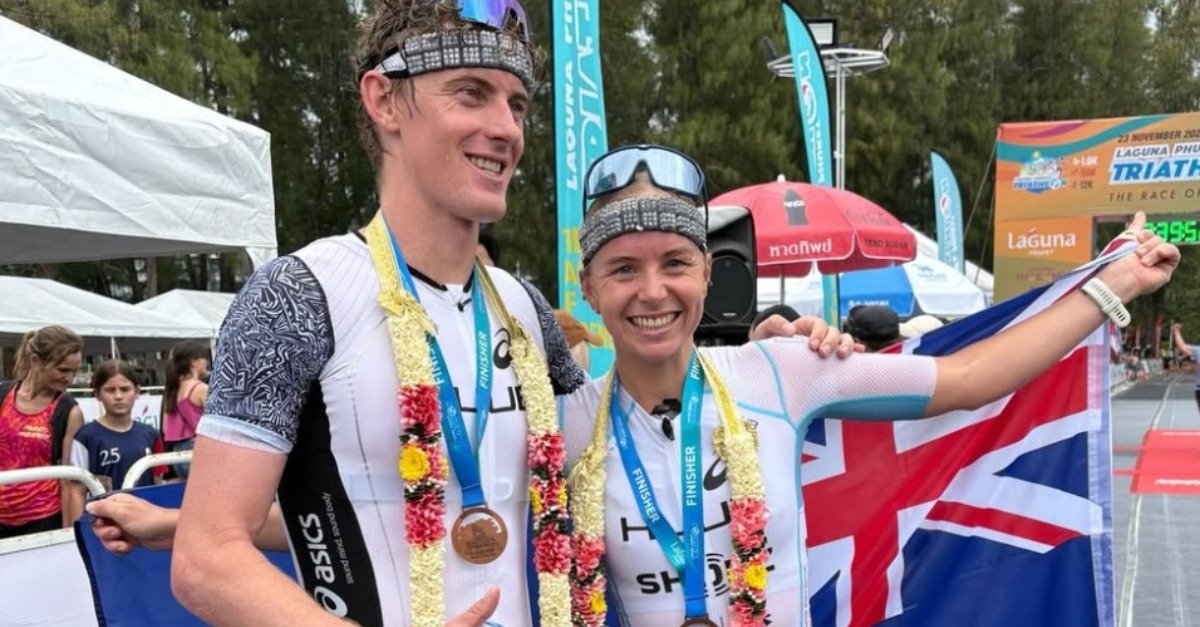
Tayler Reid and Nicole van der Kaay share a fit, globetrotting life together and this weekend very similar goals on the Gold Coast.
The decorated Kiwi couple arrive at the 2026 Oceania Triathlon SuperSprint Championships in Runaway Bay in the fight for Team NZL Mixed Relay slots and to begin rectifying respective world rankings that don’t truly reflect their standing in global short course swim, bike and run.
Reid is 83rd on the World Triathlon rankings list. Van der Kaay is 70th. For a Tokyo Olympian and a dual Olympian respectively, those numbers are an anomaly rather than a verdict — the product of injury absences and, in van der Kaay’s case, a deliberate post-Paris pivot to mid-long distance racing that has seen her climb to 50th in the separate PTO World Rankings.
The two ranking systems measure different worlds: the PTO rewards the Ironman, 70.3 and T100 set, while World Triathlon’s list is the one that opens doors to WTCS start lists, where fields are capped at 55 and ranking points are Olympic currency. Getting inside that number, or close enough to benefit from country quotas and late withdrawals for each WTCS start, is the short-course priority for both athletes as the LA28 cycle gathers pace.
The Olympic qualification window doesn’t officially open until May 18 so nothing that happens at Runaway Bay this weekend counts toward LA28 points directly.
But with selection for the two counting European WTCS Mixed Relay campaigns that follow — Quiberon (France, June 21-22) and Hamburg (Germany, July 12-13) — partly tagged to performances at the Gold Coast Performance Centre, this weekend very much counts.
It’s the last ‘domestic’ trial before those teams are named, which means Runaway Bay is where Tri NZ’s selectors start making decisions that will shape the first meaningful chapter of New Zealand’s Olympic campaign.
Why the Mixed Relay is the key to LA
Of the 55 Olympic spots available per gender at LA28, 22 will be filled through Mixed Relay qualification alone. Each nation that qualifies a relay team automatically secures two men and two women for the individual races. That makes relay racing the single most powerful qualification lever in the system — more so than any individual ranking result. For Tri NZ, a top-eight finish on the Mixed Relay Olympic Qualification Ranking is considered a realistic and sufficient target, and the 2026 European campaign is the first meaningful opportunity to bank points toward it.
The return of Tayler Reid
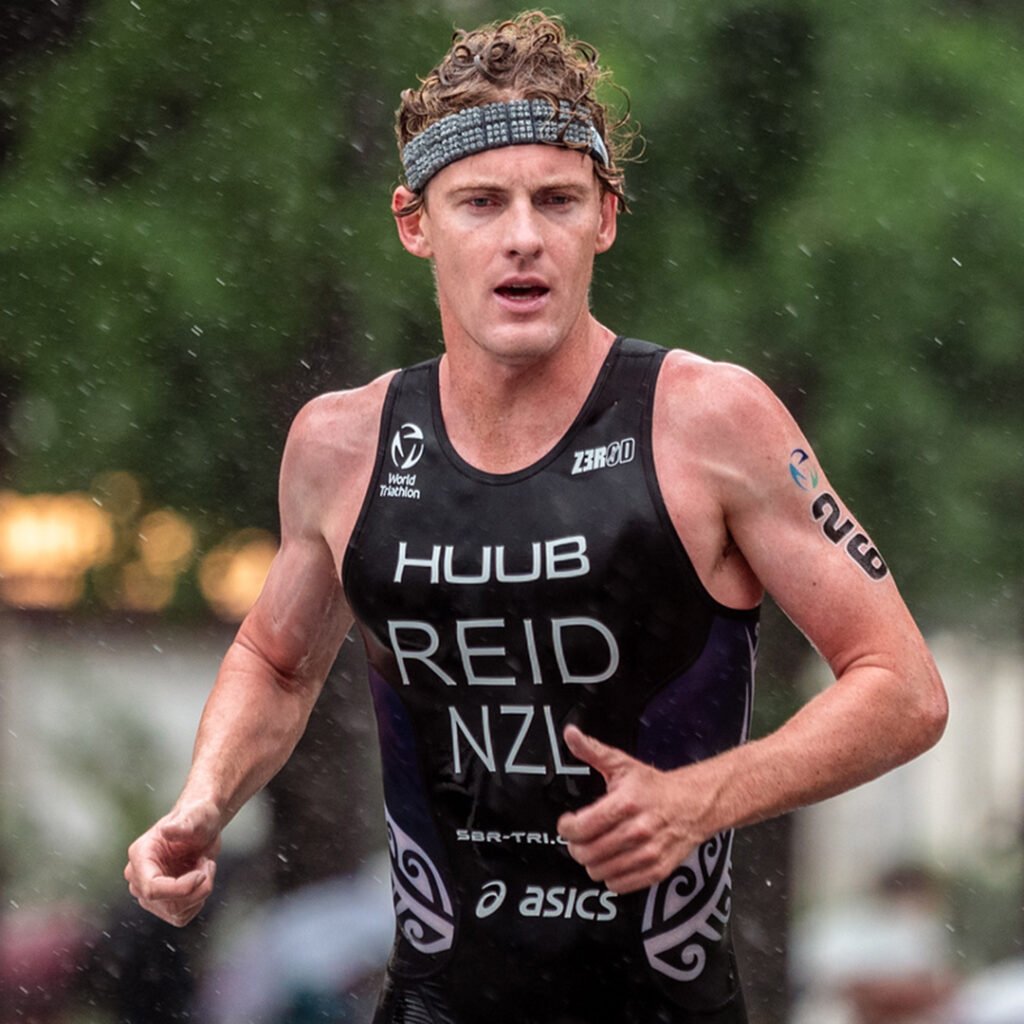
The most anticipated storyline heading into Runaway Bay is the return of Tokyo Olympian and Paris reserve Tayler Reid. This is his first start of 2026 after a rib injury sidelined him through the early season, and his first race back since he claimed victory at the iconic Laguna Phuket Triathlon in late November. His most recent World Triathlon circuit appearance was a 19th-place finish at WTCS Karlovy Vary last September.
Reid arrives at Runaway Bay with a clear mission beyond the Oceania title. Currently ranked 83rd on the World Triathlon rankings, he needs to climb inside the top 55 — or close to it — to secure guaranteed starts at WTCS level, where fields are capped at 55 and country quotas limit entries to three per nation. World Cup Chengdu on May 9 is next on his radar as he begins that rebuild. A strong performance this weekend would be a timely statement to selectors that Reid, one of Tri NZ’s most experienced relay operators, is ready to be part of the European campaign.

NVDK: Defending champion with a point to prove
If Reid is the men’s headline, Nicole van der Kaay is the women’s. The dual Olympian and defending Oceania SuperSprint champion arrives having taken a deliberate detour through the mid-distance world since Paris that has paid rich dividends. A win at Ironman 70.3 Shanghai last May, qualification for the 70.3 World Championships, and a standout fourth place on T100 debut at Gold Coast on March 4 have pushed her to 50th in the latest PTO World Rankings.
But short course is where her Kiwi crown sits. Currently ranked sixth in Oceania and third among New Zealand women behind Gold Coast-based Eva Goodisson (Oceania No.2) and the injured Ainsley Thorpe (No.5), those rankings don’t fully reflect what van der Kaay is capable of when she’s locked in on sprint-distance racing. She’s been training on the Gold Coast since her T100 campaign and arrives well acclimatised. Her only other short course start in 2026 was a 7th at the Oceania Sprint Championships in Napier on March 1 — second Kiwi home behind Goodisson’ in 5th. Whether her return to sprint-specific focus reverses that order this weekend will be one of the most closely watched battles on course.
The Women: Depth, form and selection pressure
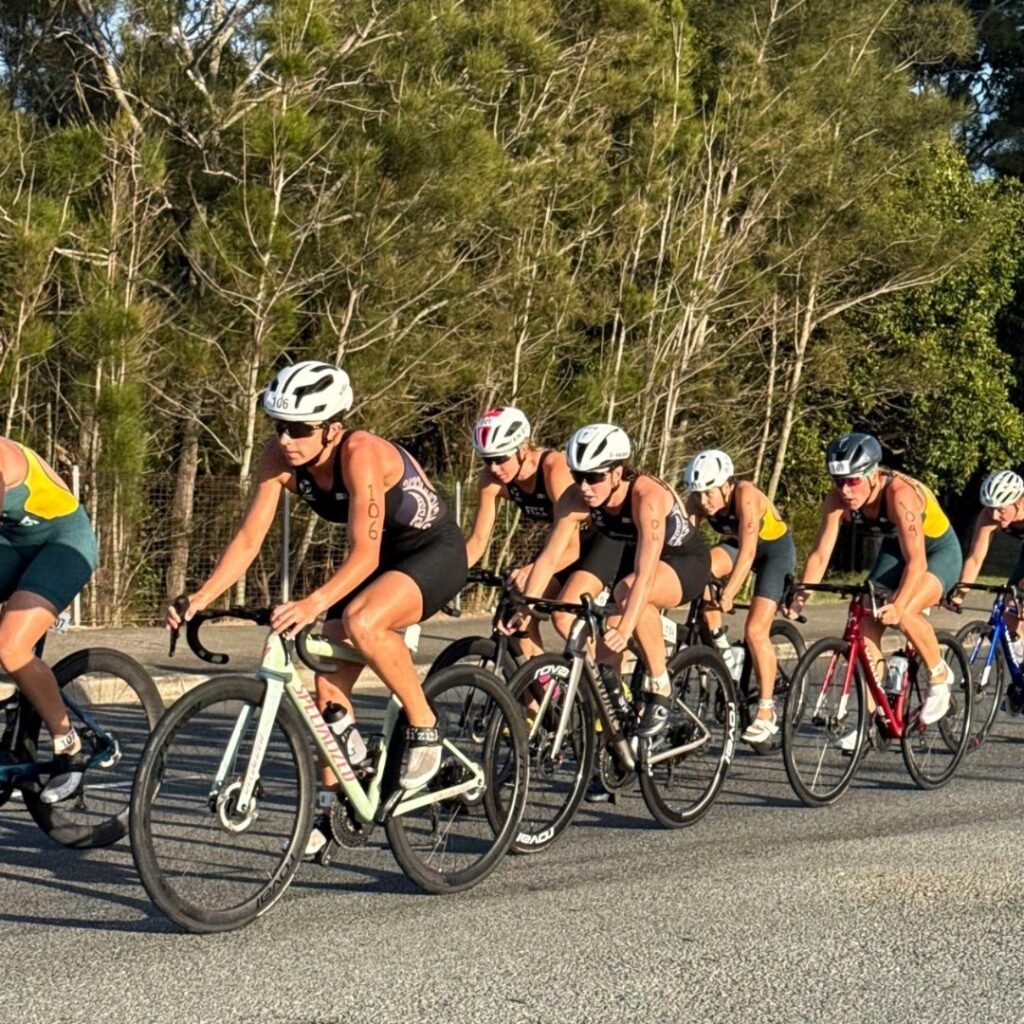
Eva Goodisson arrives as the form short-course Kiwi and a genuine title contender. Her bronze medal at Runaway Bay last year was a breakthrough continental result, and she heads into this weekend with a week’s taper after a big training block following last weekend’s Oceania Cup Gold Coast at Broadwater, where she finished 4th — a result she will be looking to improve upon. Australian Charlotte Derbyshire is the No.1 seed, with Broadwater winner Sophie Malowiecki seeded 3rd.
Beneath the headline names, the rise of Phoebe Carter is one of the most compelling sub-plots in the Kiwi women’s field. The U23 athlete finished 9th at Broadwater, edging Paris reserve Brea Roderick in 10th, in a result that followed Carter also getting the better of Roderick at Tri NZ’s recent High Performance Forum in Mt Maunganui, where the super sprint trial turned aquathlon (weather enforced) gave selectors a sharper look at the next generation. Roderick, a relay-experienced athlete, will be hungry to reassert herself this weekend.
The Men: A champion to defend, a winner to beat
Saxon Morgan is the top men’s seed and enters Runaway Bay in career-best early season form. His bronze at last year’s championship was one of his best continental results — until he eclipsed it with silver at the Oceania Sprint Championships in Napier on March 1. The 25-year-old Cantabrian has quietly established himself as one of the most consistent short-course performers in the Kiwi programme, and a strong result here, combined with his Broadwater 4th last weekend, would strengthen his relay case considerably. He, too, is in the frame for Chengdu alongside Reid and Joel Lange.
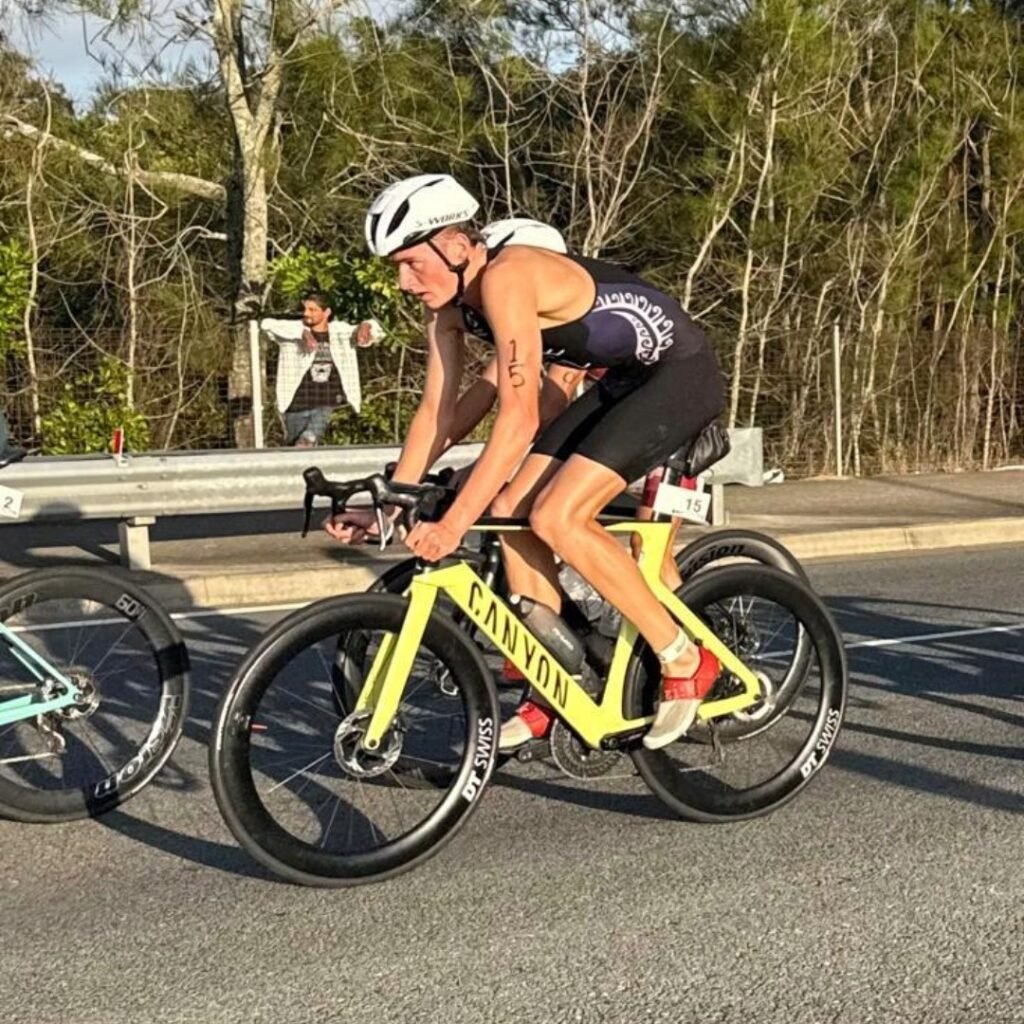
Morgan will need to be at his best. Broadwater winner Brayden Mercer arrives as the in-form Australian, and the Schofield twins Jayden and Luke — second and third at Broadwater respectively — are ideally suited to the short, sharp SuperSprint format. Luke Schofield is the defending men’s champion and will be hell-bent on a successful title defence on home soil.
Among the Kiwis to watch further down the field, Sydney-based Joel Lange had a career-defining 12th at Runaway Bay last year and will be looking to at least repeat his A Final appearance. Finnley Oliver is another name worth tracking. The Tauranga youngster made the A Final here as a U19 in 2025 and has now stepped up to the U23 ranks, though he is working his way back from injury. Making the A Final again this weekend would be another encouraging marker.
Last weekend at Broadwater, Robbie White was the next best Kiwi man after Morgan in ninth (53:07), with Gus Marfell (53:43), Oliver (53:47) and Lange (54:02) filling out positions 14 through 16. There’s motivation right there.
How the racing works
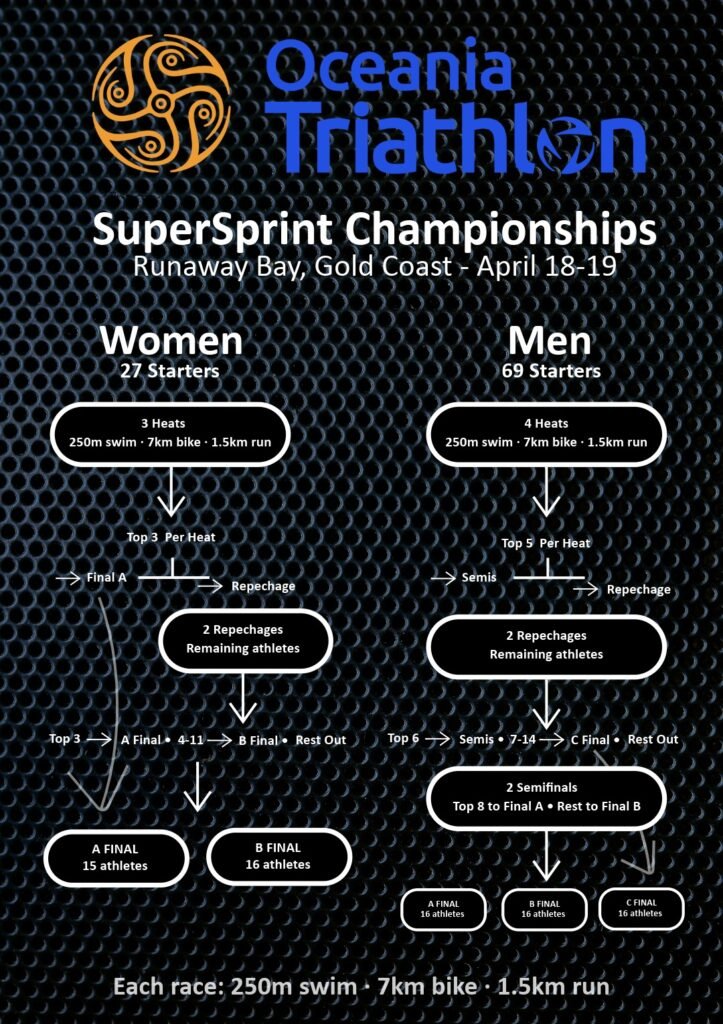
Every race at the Oceania SuperSprint Championships is contested over the same course: a 250-metre swim in the Gold Coast Performance Centre’s outdoor pool swim, a 7km bike leg around the outskirts of the facility and a 1.5km run on the central athletics track. But the road to the final looks different depending on whether you’re racing in the women’s or men’s field
Women
The field of 27 will start in with three heats. The top three finishers from each heat qualify directly for the A Final. Everyone else heads into one of two repechage races for a second shot. From those repechages, the top three in each earn a place in the A Final alongside the heat qualifiers, positions four through 11 go to the B Final, and anyone outside that cut is elimiated. That gives you a 15-athlete A Final and a 16-athlete B Final.
Men
The larger 69-strong field means a more complex draw, with four heats rather than three. The top five from each heat advance to the semi-finals. Those who miss out drop into a repechage, where the top six from each repechage race still make the semis — but positions seven through 14 are redirected straight to the C Final rather than being eliminated. From the two semi-finals, the top eight go through to the A Final and the rest contest the B Final. The men’s competition therefore concludes with three finals — A, B and C — each carrying 16 athletes.
A note on the format
While U23 and U19 athletes are among the Kiwi starters listed below for context, The Oceabia SuperSprint Championships is an open, elite competition — no age group titles or medals are on offer. That said, selectors will have one eye on October’s Junior (U19) and U23 World Championships in Pontevedra, Spain, and performances this weekend will inform that conversation too.
Every race is a 250m swim, 7km bike and 1.5km run. For the full race progression format, see the graphic above.
2026 Oceania Triathlon SuperSprint Championships — Runaway Bay Kiwis*
Women
Elite: Natasha Bowyer · Eva Goodisson · Emily Irvine · Amara Rae · Brea Roderick · Nicole van der Kaay
U23: Maia Adams · Charlotte Brown · Phoebe Carter
U19: Charlotte Chiles · Sophie Garrett · Sophie Webber · Indie Williams
Men
Elite: Joel Lange · Gus Marfell · Blake Miller · Saxon Morgan · Tayler Reid
U23: Ben Airey · Oliver Larcombe · Ryan Marfell · Henry McMecking · Finnley Oliver · Oscar Skinner · Will Taylor · Grayson Westgate · Robbie White
U19: Alec Ball · Connor Kemp · Sam McHale · Caleb Wagener
*The SuperSprint Championships are an open race but SBR-Tri has grouped the Kiwi starters by age group for context.