World Triathlon’s qualification system for the LA 2028 Olympic Games has just been ratified by the International Olympic Committee (IOC), and while the headline numbers haven’t changed, the way athletes – and nations – qualify most definitely has.
For New Zealand’s Olympic triathlon hopefuls, the message is simple: the road to Los Angeles runs through the Mixed Relay first with individual ambitions heavily dependent on that outcome.
Here’s how it breaks down:
The big picture: Two pathways, one reality
Team NZL has two primary qualification routes:
- Mixed Relay (MR) qualification
- Individual Olympic Qualification Ranking
They are not equal in influence.
Now the IOC has ratified the system, Tri NZ can nail down its own nomination and selection criteria. That is scheduled to be done by the time Tri NZ’s annual domestic High Performance Forum, this year in Mt Maunganui, rolls around in late March.
In practical terms, Mixed Relay success determines how much room individual athletes have to qualify. Get the relay right, and the individual pathway becomes far more forgiving. Miss it, and margins get razor thin.
Mixed Relay: The cornerstone of New Zealand’s LA28 strategy
Why the MR matters so much
If New Zealand qualifies a Mixed Relay team, it automatically secures:
- 2 men
- 2 women
That’s four individual Olympic slots locked in before individual rankings are even finalised.
Across the Olympic field, 22 of the 55 places per gender will be taken via host nation (Team USA) and Mixed Relay pathways. That makes relay racing the single most important qualification lever.
The 2026 races that matter
The LA Qualification window runs May 18, 2026 to May 18, 2028 and is split into two, year-long halves. In each year-long qualification window, three Mixed Relay races count. In 2026, that makes the following WTCS/Mixed Relay weekends a strategic focus for Team NZL:
May 31–June 1: WTCS Alghero*Ed’s note: Alghero MR cancelled. Now only a standard distance race on May 31 (NZT)- June 21–22: WTCS Quiberon*
- July 12–13: WTCS Hamburg – World Championships
*World Series Mixed Relay
Hamburg is the biggie. As the World Championships, it carries automatic LA quota allocation for the winning nation and significantly more points than regular World Series Mixed Relay events for every other country. World Cup and Continental Mixed Relay Championships offer fewer points again.
If you’re mapping the Olympic pathway, Hamburg is circled in red.
Continental chess match: Australia looms large
One of the major changes for LA28 is a new safety valve:
the highest-ranked nation from each continent not otherwise qualified can earn a Mixed Relay slot.
For Oceania, that puts New Zealand and Australia into a direct contest.
Tri NZ would prefer not to rely on Continental Championships for points but it must be aware of Australia’s position at all times. Blocking points sounds simple in theory; in reality, Australia are the reigning Mixed Relay world champions and consistently one of the strongest teams in the world.
What does qualification success look like?
Assuming New Zealand does not win a World Championship in 2026 or 2027 (they’ll certainly be trying for that outcome), history suggests that a top-eight ranking on the Mixed Relay Olympic Qualification Ranking is likely to be enough to secure an Olympic relay spot.
That’s the realistic target and the platform everything else is built on.
Individual qualification: Opportunity, but with conditions
Individual qualification runs alongside the relay pathway, but it is tightly structured.
How individual rankings work
Within each year-long qualification window:
- A minimum 5 and maximum 7 races count
- At least two must be standard-distance events
That detail matters and needs to be explicit: sprint-heavy schedules alone won’t cut it even with the weighted Mixed Relay (and its quick-fire distances) pathway being the smart strategic qualification route.
The ultimate goal: Three athletes per gender
A National Olympic Committee can qualify:
- Up to three athletes per gender only if all three are ranked inside the world top 30
- Otherwise, the maximum is two
For New Zealand, the strongest opportunity looks to lie on the men’s side.
Kiwi Men: A genuine three-slot opportunity
New Zealand has rare depth here:
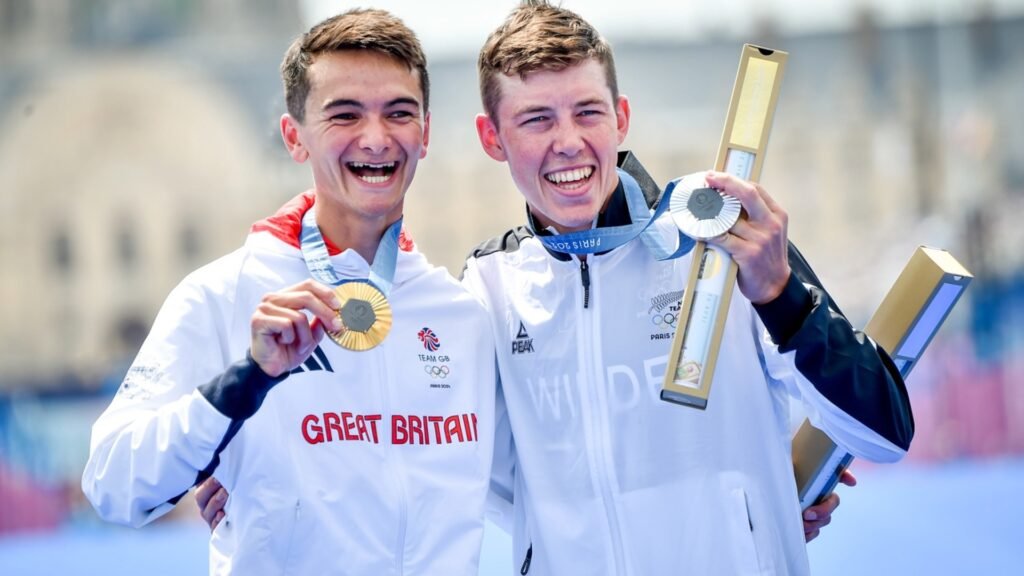
- Hayden Wilde – Olympic bronze (Tokyo), Olympic silver (Paris)
- Dylan McCullough – Selfless Olympic debut in Paris, effectively serving as a domestique for Wilde
- Tayler Reid – narrowly missed Paris selection after repping in Tokyo
All three have realistic ambitions of pushing inside the top 30 world rankings but won’t have it easy, neither with the increasingly fierce global competition, nor from domestic competition with the likes of Saxon Morgan, Henry McMecking, Sam Parry and Gus Marfell all quietly chasing the LA dream.
For Paris, Tri NZ’s push for a third men’s slot came late. Tri NZ’s new CEO, Pete De Wet, and the new General Manager of Performance, Travis White, only arrived midway through the cycle, and race selection wasn’t aggressively targeted early enough.
For LA28, that changes. Expect deliberate, strategic race targeting from the start, aimed squarely at maximising ranking outcomes.
Kiwi Women: Incumbents have competition
On the women’s side, the picture is more fluid… and more competitive.
Olympic incumbents Nicole van der Kaay and Ainsley Thorpe (both Tokyo and Paris representatives) now face genuine pressure from the next wave:
- Eva Goodisson
- Brea Roderick (Paris reserve)
A key moment looms in late March, when Tri NZ hosts its annual Performance Forum in Mt Maunganui including a trial Super Sprint race.
That event, to be played out on the sidelines of the Tri NZ Suzuki Series NZ Schools Triathlon Championships, won’t decide Olympic selection. What it will shape is how the next phase of the campaign unfolds, particularly around relay composition for this year’s three key European WTCS/MR events and head-to-head benchmarking.
The bottom line
For Team NZL hopefuls, the LA28 qualification message is clear:
- Mixed Relay success is non-negotiable
- Individual dreams are strongest when built on relay qualification. Strategic race selection matters more than ever. Depth, not just star power, will decide who makes the plane to Los Angeles.
The system hasn’t just been tweaked, it’s been designed to reward nations that think and act like teams.
And for Tri NZ, that thinking has already begun.
Global Context: How qualification works for LA28
Like Paris 2024, triathlon at the LA28 Olympic Games will feature 110 athletes (55 men and 55 women) competing across three medal events: Men’s Individual, Women’s Individual and the Mixed Relay.
Athletes qualify between 18 May, 2026, and 18 May, 2028, through a combination of Mixed Relay results, individual world rankings, continental pathways and universality places.
Mixed Relay qualification plays a central role. Nations can secure Olympic quota places by:
• Winning the 2026 or 2027 World Triathlon Mixed Relay Championships
• Ranking highly on the Mixed Relay Olympic Qualification Ranking
• As host nation, the USA is guaranteed one relay team (2 men, 2 women), provided eligible athletes are available
Through host and relay pathways, 22 of the 55 places per gender will be allocated.
Individual qualification is primarily determined by the Individual Olympic Qualification Ranking, with 21 places per gender available. Athletes must count five to seven races per qualification window, including at least two standard-distance events.
To ensure broader global representation, World Triathlon has expanded the “New Flag” pathway, guaranteeing two qualification opportunities per continent (via Continental Games and World Ranking) for nations not otherwise qualified. Additional universality places may be awarded to under-represented countries.
Each National Olympic Committee (NOC) may qualify up to three athletes per gender, but only if all three are ranked inside the top 30 globally. Otherwise, the limit is two per gender.
How the 55 Olympic spots per gender are allocated
In short: 11 relay teams (22) → individual rankings (21) → New Flag (10) → universality (2) = 55.
Here’s how it breaks down per gender:
1️⃣ 22 of the 55 spots come from Mixed Relay teams
Each qualified Mixed Relay team = 2 men + 2 women
11 teams qualify → 11 × 2 = 22 spots per gender
👉 That immediately takes the total from 55 → 33 remaining
2️⃣ 21 spots go to individual qualification
Allocated via the Individual Olympic Qualification Ranking
These are awarded after Mixed Relay quotas are removed
👉 22 (relay) + 21 (individual) = 43 spots per gender
3️⃣ Up to 10 “New Flag” spots are added
2 per continent (one via Continental Games, one via World Ranking)
Only for nations not already qualified
👉 43 + 10 = 53 spots per gender
4️⃣ Up to 2 Universality places complete the field
Awarded by the Tripartite Commission to under-represented nations
👉 53 + 2 = 55 total spots per gender